Mobile games can be hit or miss, but the ones that stick usually have two things in common: a compelling hook that grabs you immediately, and a progression system that keeps you coming back. Last week I decided to make prototypes around that philosophy.
I chose the ideas by combining market trends with my own interests: 🧩 Match-3 is still one of the biggest genres on mobile, so I wanted to see what twist I could bring to that formula. 🏆 Asynchronous multiplayer has always been one of my favorite mobile mechanics, so I explored a concept built around that. 🐍 I've kept snakes for years, and while breeding them isn't something I can realistically do, designing a game around genetics and collection absolutely is! The goal wasn't to build complete games. It was to validate whether each concept had the foundations to become one. For each prototype, I focused on just two pillars: • A core gameplay hook that feels fun within the first minute. • A progression loop that gives players a reason to come back. I put together a short video showing all three prototypes. I'd love to hear which one you'd be most interested in playing!Friendslop Prototype
This is a quick write up of the last 2 weeks of my prototyping journey. Thank you to all those who participated in my playtests, it means a lot! Before you read on, here's a quick video of the current state of the prototype.
Networking Is Scary
From all my prototyping, I never ventured into the realm of multiplayer. It always seemed too daunting for a solo project. That's something I need to shake. If Lil Laundry Lane has taught me anything, it's that I need to get out of my comfort zone if I want to expand my toolkit, expand what kind of games I can even think of making. So in that spirit, I dove head first into making a quick 'Friendslop' prototype.
Turns out simple networking isn't so scary, there are some easy to use 'out of the box' solutions. Unity's Networked Game Objects (NGO) is surprisingly easy to setup, although scary to see the pricing charts! It's also awesome to see that Steam has a free Relay service and there's several community backed wrappers like Facepunch. I know that what I've gotten into wouldn't scale at large, and it would not work in a competitive environment, but for Friendslop this is a perfect start.
My initial test was simple - can I get two characters moving around and tossing stuff around? After a day I was able to get something up and running... just seeing this gave me a lot of hope that I could start developing a Friendslop game given the right idea.
Enter Meccha Chameleon
Lately, I've been seeing a trend in games taking off that make me think ... 'I could build something like that'. It's a weird feeling, a sense of inspiration mixed with a bit of envy. I know finding the right idea is key, execution is another element to the success, but I can't help but think I can be there too. The latest one that really hit me was Meccha Chameleon. It's 'prop hunt, but you paint yourself' -- a concept so simple that it's described in one sentence, and a short one at that.
After playing it, I remember having similar feelings about another game I played in a small co-op setting: Schedule I. That game was 'drug dealing with your friends'. Both of these games are not complicated premises but they provide a playground for players to have fun and enjoy the company of their friends. After making the simple networked example, I keep thinking... 'hey, I can build that...' but what I lack is the core nugget of an idea to execute on.
New Life Into an Old Jam Project
When I was at Blizzard, I participated in a game jam where we came up with one of the coolest ideas ever -- you're a spider and you lost your eyes! I thought the concept was super cool but we never took it further than the one level we created. I decided to revisit that concept but as a Friendslop game, similar to Meccha Chameleon... what if your friends could hide your eyeballs? That was the inspiration of this project.
Iterate, Iterate, Iterate!
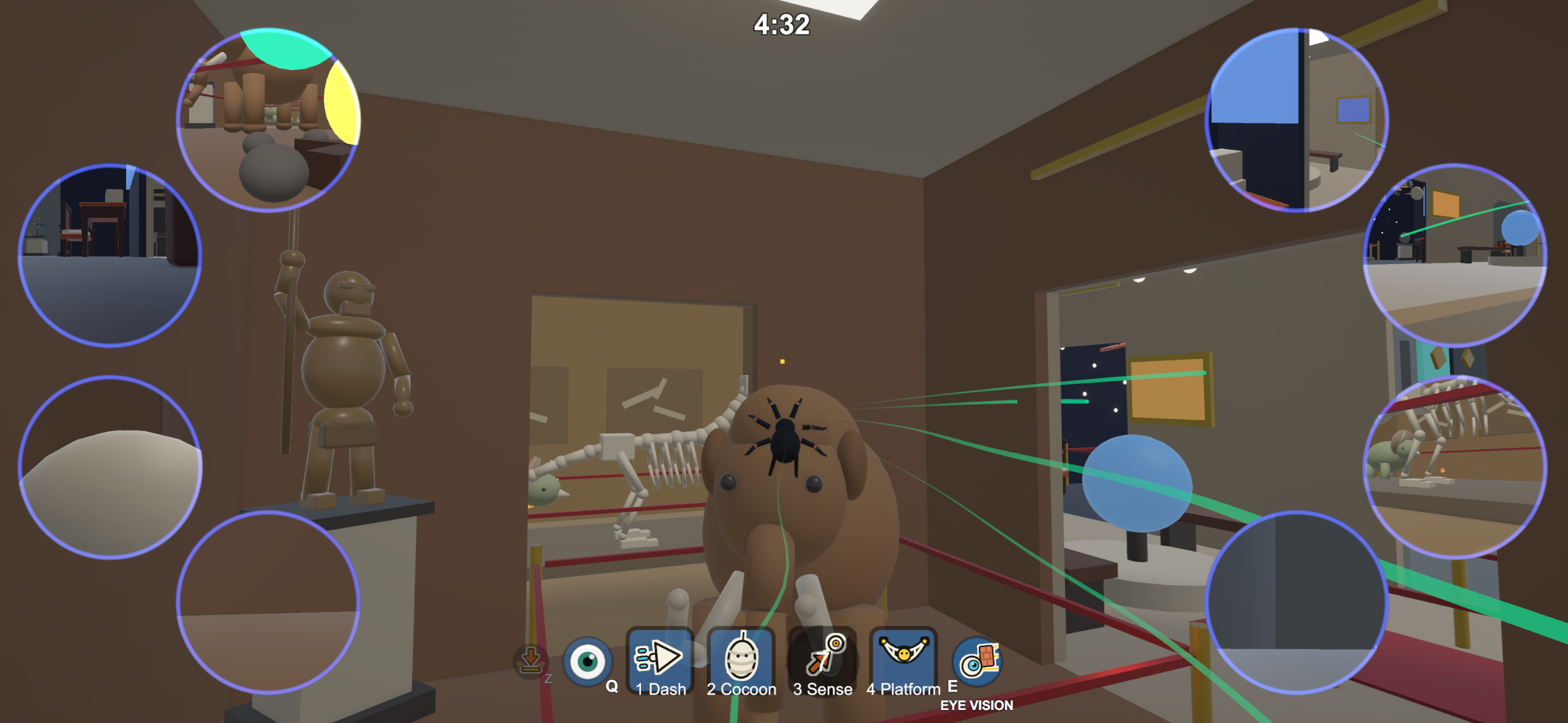
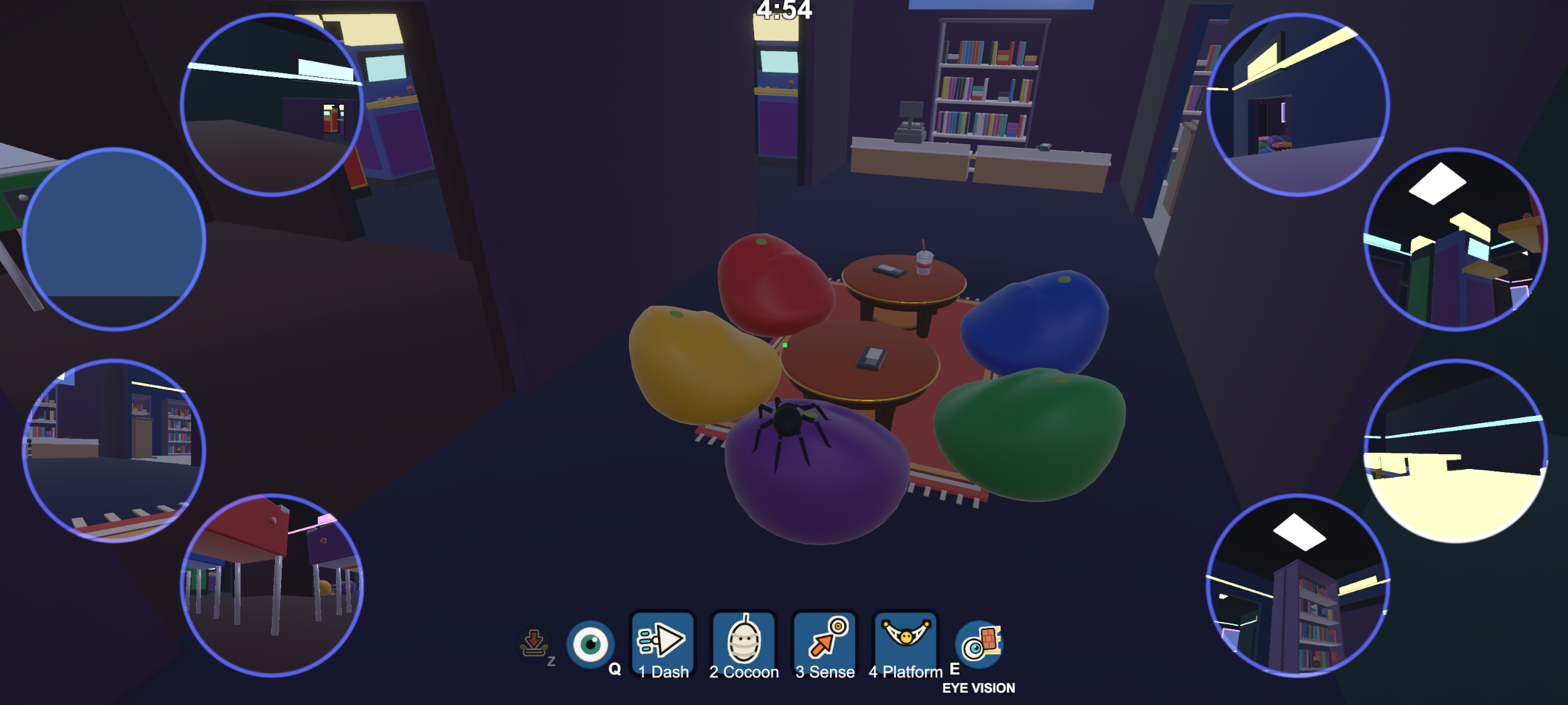
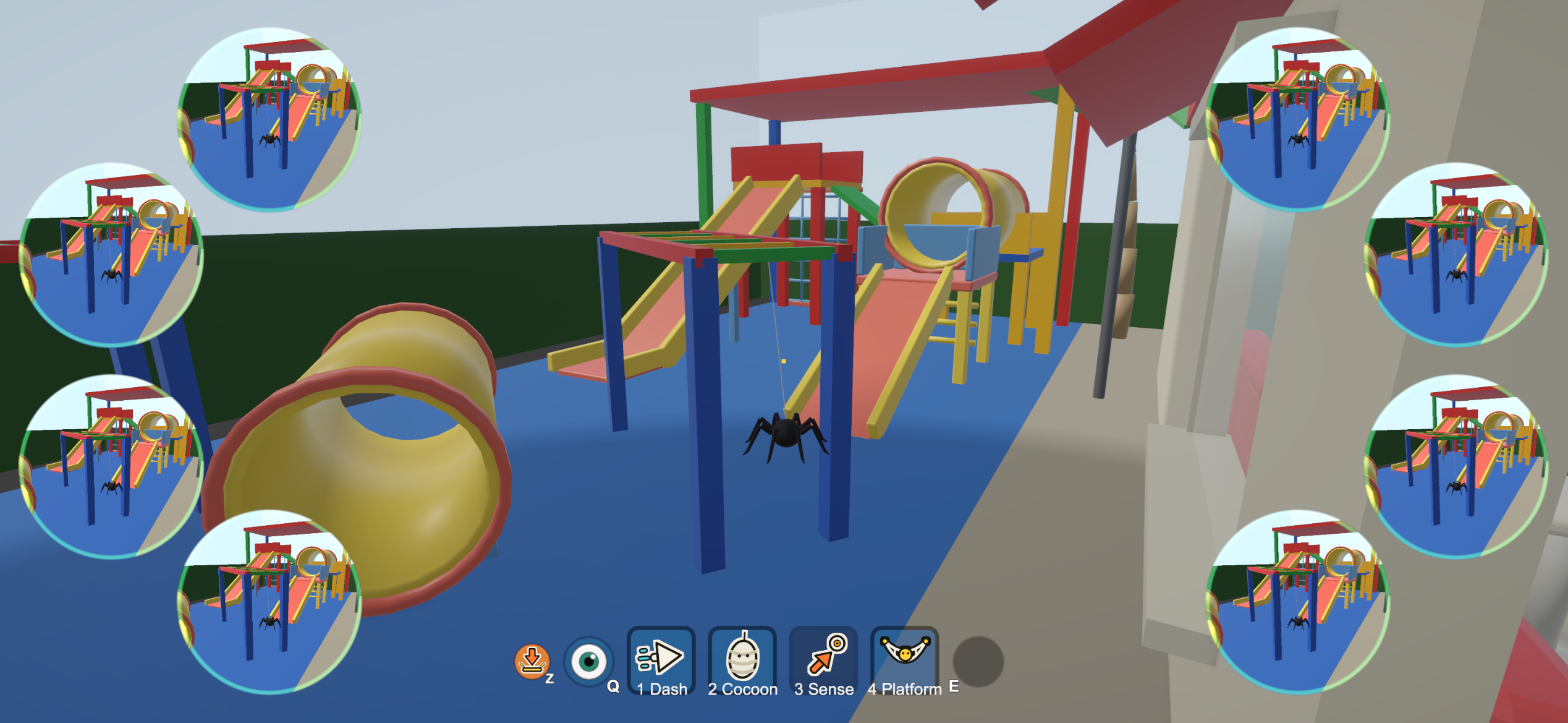
At first I tried to simply recreate the original idea - your eyes are cameras and give you hints on where to find them. Once you find them, your vision improves until you ultimately recover them all. Implementing it wasn't so bad, simply have an overlay of the normal camera, create a render texture and map all the camera outputs to the texture depending on if the eye was attached or not. A bit of special logic when you only have the single middle camera because it's more fun that way. But after showing this to a few friends, the consensus was that this felt jarring. So I experimented with more views of the same concept. What eventually felt right was keeping a main camera with 'eye bubbles' for the other eyes.
More and more playtesting of the web-slinging and wall-crawling made me discover that the game would best be served as third person with a more natural eye bubble patter. What I ultimately landed on feels better to play and lets you still get a sense of being a spider.
Then one of my friends had a cool idea - what if you could see through an eyeball camera at any time? The idea ended up feeling really good and fitting the game's mechanics so well I kept it as a core ability.Game Mode, Power Ups & Playtesting
Once I was happy with the eyes-as-cameras mechanic, the web-slinging, and wall-crawling, I worked on making the game mode networked across multiple clients. This is where I had some trouble because of my inexperience with network programming, but ultimately was able to produce what was in my head. Players start the match by hiding each others eyes, then try to find them before the rest!
Once I got the basics in, I wanted to add some spice into the movement and give players tools for finding their eyes. I started with simple things like a Dash, Speed Boost... and gave some more interesting things a try like Cocoon Shots that can stun other players, and platform generating web shots. Ultimately I tried 10 skills across 3 playtesting sessions with friends. Ultimately, I found that some abilities like 'Super Jump' and 'Speed Boost' were good, they made traversing trivial and took away from the spider-feel. I ended up with 4 abilities, a 'take over the camera' special, and a 'Mario Kart' inspired secondary special ability that I can playtest even further.
This is 2 weeks worth of prototyping... I can't wait to see what I can build in the future. Thanks for reading :)
Cozy: Designing Out of My Comfort Zone
From Rejection, Comes Introspection
I remember applying to a role at Netflix that I thought I would be a good fit for based off the job qualifications. I hit every checkbox they wanted... I prototype all the time, I am technical enough to create stuff on my own, and I have the ability to design compelling content and systems (at least I think I do). But the recruiter and hiring manager didn't want to give me the chance to meet the team because they thought their game was not in my wheelhouse. Their game was a cozy game. I had never designed or worked on one, so what could I do to refute that?
I'm not one to argue about my capabilities to people I hardly know, and perhaps they were right about me being a bad fit for their team because I've never made a cozy game. I've played a few, but I wouldn't consider myself a core cozy gamer. This rejection really made me think about the role of game designers, and how they are met with a distinct challenge in development: sometimes you have to aim to design for games you don't play yourself. It's a strange parallel to programming. It's like asking a UI programmer to make Combat systems, or ask a Network programmer to make content authoring tools. To me, the lines are way more defined.
This whole interaction got me thinking about how I put myself in a bubble by designing and playing the same type of games. So I made an effort to expand my knowledge by venturing into the cozy game space. I picked up a few obscure mobile games in the space, played several hours of popular games like Stardew Valley, and even tried to cross reference some cozy design elements from my current library - like Valheim's building and farming systems.
And I watched a TON of Good Pizza, Great Pizza content. There's so much out there. The game really resonates with the calm, relaxing, cozy side of the gaming world. So, I went forth into creating a game in this space. That became Lil Laundry Lane.

Prototype to Steam Demo
The next 3 months that followed my decision was a full pipeline of game design, prototyping, iteration, and ultimately a Steam ready product. This is definitely the fastest timeline I've ever made Steam product -- okay well to be fair there haven't been many -- and I'm quite proud of the result. This is the first time I've aimed to create a game that wasn't meant to be finished quickly or gamed to get the most out of it in the least amount of time possible. It was made to reflect what I was seeing in the cozy game design dive I had recently been going through.
Sadly I did not make a good record of my progress, but I did find a few videos I kept to show people progress along the way. The earliest video I have is on April 8th of this year. I believe this was after the first full day working on the project. I had barely gotten some of the UI in place (non-functional), a skeleton version of a dialog system, and the start of the minigame in place. It's not much but making progress always feels good, especially in a dark time like post layoffs.
A week later I had fleshed out the design document for the core minigame enough to implement it out and playtest. I found some random art pieces that would work to sell the idea and slapped it all together. It looked quite basic but a lot of the foundation was in place. Being in 2D really helped because I could get away with using colored planes for most of the art. The exception being the T-Shirt... but I found a good temporary artwork that let me experiment on shaders to make the dirtiness + lint mechanics I had envisioned.
Another few days and I started thinking about longer term game progression, which is how I designed a shop system to unlock more items and eventually customization options. Still a lot of temporary art, but that's to be expected. Around this time, an artist I had been in contact with began funneling in assets that I worked into the game over time. It's always nice to see something shape up from squares and boxes to materialize into what you have in your head...
Even for simple games like this, game feel and iteration are key. I went through so many trial and error iterations on how the clothes shader would work, which tools to add to the game to add as features, and even how to load the washing machines/dryer. I think I had 4 different versions of that until the artist and I nailed the final implementation. That's the kind of work I live for -- and it doesn't matter if its about a washing machine, or lint roller, a fireball's thrown arc, or the feel of an axe going through enemies...the collaboration to improve a game... there is no better feeling.
3 Months Later
I've been working on this project and and off for 3 months while I search for work. I can honestly say that it's let me express my design skills in a way that my professional projects usually don't let me. Working 1-on-1 with an artist, creating mechanics and systems from scratch, cutting things that didn't feel right -- these are all things that I want to keep doing in a professional setting.
At any rate, at the very least I have another product I can point to and say that I created. I'll leave this blog post with a the first trailer for the game I made. It's quite bad, but hey, I'm also learning to edit videos and make blog posts too! It shows how far the game has come, but the video is already an old version... that's what's so great about building a project, it keeps changing! Please go check it out on Steam!
Epic Layoffs
Layoffs in the Gaming Industry
I am back from my honeymoon and have found out that I have been laid off from Epic Games. What a whirlwind of emotions. To date this is the third time I've been 'caught' by a layoff, where I've escaped three others as well. It's a little odd to think that I'm used to this. I sometimes wonder what industries are like. Does everyone expect this? The gaming industry is fickle, I suppose. I see it in entertainment in general. While I suspect that it's part of the price we pay as creatives, it still hurts emotionally when it happens.
I'm going to look at this as a positive. I have more time to experiment with indie games. I have more time to play the games I've been putting off. I have more time to spend with my wife and cats.
...and yet, all I can think about is what game I should make next...
Welcome
Welcome to my blog.
If I find time this is where I'll share updates about my game prototypes, development insights, and thoughts on games I'm currently playing.
I'm excited to share this journey with you. Check back soon for new posts!